The right TV cabinet should be based on the actual width of your TV and not just the screen size. The correct measurement will enable you to select a cabinet that will fit the TV perfectly and, at the same time, create enough room for you to walk past. This Cassa Vida guide gives you a size chart for every common TV, the rules behind it, and what to check for height, depth and weight before you buy.
The quick answer
The TV unit you will purchase must be at least 20cm wider than the TV to make sure that you have space on each side. When choosing the TV unit, consider one that will accommodate the TV in 60% - 80% of its width.
When it comes to size, you will need a TV unit that is between 1.6 to 2m for a 55-inch TV, 1.8 to 2.4 m for a 65-inch TV (2 m is ideal) and 2.2 to 2.4 m for a 75-inch TV. View all our entertainment units, which range from 1.2 m to 2.4 m in width.
TV unit size chart: which width is for your TV
Below is the television width, including the frame, which is approximately 2 cm. Remember to always verify this from your model’s spec sheet.
|
TV size |
TV width (approx.) |
Minimum unit width |
Best-looking unit width |
Cassa Vida units in this width |
|
43-inch |
97 cm |
1.2 m |
1.3 to 1.6 m |
|
|
50-inch |
113 cm |
1.4 m |
1.5 to 1.8 m |
|
|
55-inch |
124 cm |
1.5 m |
1.6 to 2.0 m |
|
|
65-inch |
146 cm |
1.7 m |
2.0 to 2.4 m |
El Nino 2m, Widden 210cm, Arvena 2.15m, Jaya 2.15m, Jenny 2.2m, Gidon 2.2m (a Marty 1.8m also works, with less space on each side) |
|
75-inch |
168 cm |
1.9 m |
2.2 to 2.4 m |
|
|
85-inch |
190 cm |
2.1 m |
2.4 m or wider |
Marty 2.4m, Adsila 2.4m, or wall-mount the TV. |
Width is just one consideration. You should also consider how the unit's weight capacity compares to your TV's weight and where your TV’s feet will be. More on both in the paragraphs below. For more information about our widest unit, take a look at Meet the Marty 2.4m.
How wide should a TV unit be?
The minimum: 10 cm spare on each side
Television sets have their dimensions measured from one corner to another. For example, a 65-inch-wide television set measures roughly 146 cm, not 165 cm. You need to calculate the width of your television and add at least 20 cm extra to that measurement. This extra width will make sure that there is no overhang and the bump in the cabinet does not interfere with the screen.
The best look: the TV takes up 60 to 80% of the unit
The TV that occupies almost the entire cabinet is cramped, as the furniture must have been designed for a smaller television. The proportions are right when the TV occupies about 60 to 80 per cent of the width of the cabinet, thus balancing out the walls with space left for a lamp, a plant, or some books on both sides. Our styling suggestions for your entertainment unit will give you an idea of what to do with it. You will have more space in drawers and cabinets too.
Should you consider buying a larger TV in the coming years, it will be wise to buy a slightly bigger unit. The Ruvo Extendable TV Entertainment Unit is another choice if you would like to have a flexible unit.
Check where the TV's feet sit.
Many TVs now have two feet near the outer edges instead of one stand in the centre. On larger TVs, these feet can be more than a metre apart. This means the TV unit must be wide and strong enough to support both feet safely. Some TVs allow you to move the feet closer together, or you can buy a separate centre stand. Before ordering a TV unit, check your TV’s specifications for the width with stand and stand footprint.
Matching the unit to your wall and room
How much wall to leave on either side
As a guideline, always verify that there is a minimum of 30 cm of wall clear space from each side of the unit to avoid the furniture looking cramped, and the pathway space in front should be kept at around 80 to 90 cm. When putting up the unit on a large wall, an ideal unit would occupy about half to two-thirds of the wall.
Open-plan rooms and corners
In an open-plan living room, the TV unit helps define the lounge area. A long, low unit often works better than a tall one. If you have limited wall space, choose a narrower unit and mount the TV on the wall to keep the floor clear. If you want a complete media wall, you can pair the TV unit with matching pieces from our display units and storage range on either side.
Lining up with the sofa
Centre the unit and TV on the seats people actually use, not on the wall. In most lounge rooms, a unit that's a little narrower than the sofa opposite looks balanced, while a unit much wider than the sofa can make the room feel uneven. For the right gaps between your sofa, coffee table and unit, see our living room layout measurements guide.
How high should a TV unit be?
Try to position the centre of the TV screen at about seated eye level. For most sofas, this is around 100 to 110 cm from the floor. If your TV sits on a unit, a low unit around 40–55 cm high usually works well.
For example, the Marty 1.8 m TV unit is 45 cm high. With the TV stand on top, the centre of a 65-inch screen sits just below seated eye level, making it comfortable to watch for long periods.
Taller units, around 60 cm or more, are often better for bedrooms, where you may watch TV while lying down, or for smaller TVs. In a living room, a taller unit can place a large screen too high.
How deep should a TV unit be?
The standard depth of most televisions ranges between 40 cm to 50 cm, giving room to accommodate the feet of the television, a soundbar and devices in the cupboards. Take measurements of the depth of the stand of your television and make sure that the top depth is bigger with some centimetres to spare. If your TV has a gaming console or set-top box, take measurements of whether there is enough space behind for the cables and airflow.
Weight, soundbars and cables
Weight: Compare the weight limit of the unit with that of your TV with the stand attached, along with the soundbar and any additional equipment installed at the top. The capacity of both Marty units (1.8m and 2.4m) is 80 kg. While most 65-inch TVs weigh less than that, bigger or older models may be quite heavy.
Soundbar: The soundbar typically goes below the TV screen, so verify that it isn’t so high that it blocks the bottom part of the screen. Low-foot TVs might require a shorter soundbar or a higher stand.
Cable management and ventilation: Find out whether there are cable holes in the back panel and sufficient ventilation for heat-emitting devices. Both Marty units have three soft-close drawers, each of which includes a cable management hole, and are delivered assembled.
Safety: In case you have children at home, it is important to secure both the television and the unit to the wall using an anti-tip strap or furniture anchor.
Materials: We use engineered wood with veneer made from oak and walnut (Marty), acacia (Crowther), New Zealand ash (Adsila) and messmate (Meadows) in our models, allowing you to match your unit with the flooring and other furniture in your home. Our guide to matching your entertainment unit to your living room furniture can help.
What if your TV is wall-mounted?
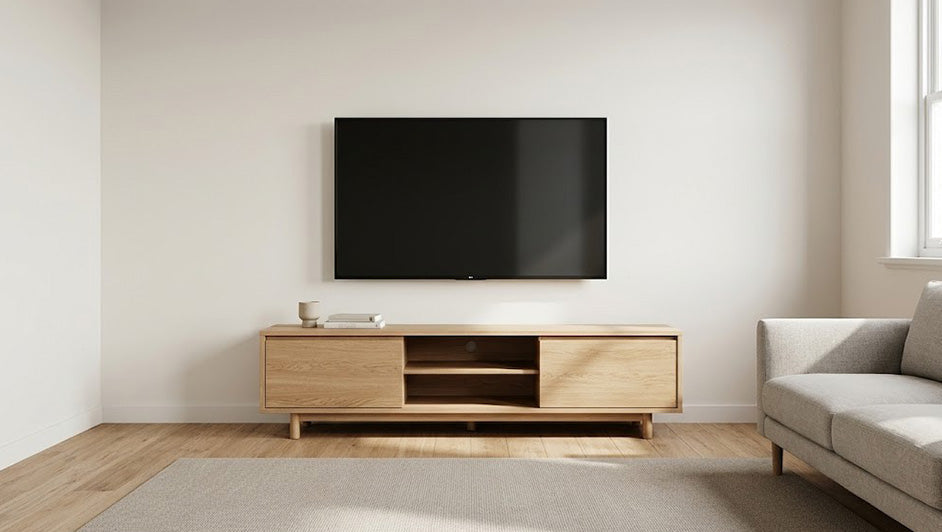
When you mount the TV on the wall, the unit no longer needs to support its weight, so its width becomes more about appearance. Choose a unit that is as wide as the TV or slightly wider. This helps the screen look balanced rather than as if it's floating above an empty space.
Leave about 15–25 cm between the bottom of the screen and the top of the unit. Keep the unit low to avoid placing the TV too high. For safety, attach the TV bracket to the wall studs and make sure it matches your TV's mounting pattern.
Frequently asked questions
How wide should a TV unit be?
It should be at least 20 cm wider than the width of your TV, with an extra 10 cm on either side. The ideal scenario would be for the TV to occupy roughly 60%-80% of the width of the entire entertainment centre. Use the total width of the TV, not the inches.
What size TV unit do I need for a 65 inch TV?
The width of a 65-inch television, including the frame, would be around 146 cm, so you should select a unit that is at least 1.7 metres wide. The ideal size for the unit would be 2 metres to 2.4 metres, but even a 1.8-metre unit will do. Remember to measure the position of the feet on the TV.
What size TV unit do I need for a 75 inch TV?
The width of a 75-inch TV set is approximately 168 cm, hence requiring a unit whose minimum width is 1.9 metres. The most appropriate unit should measure between 2.2 and 2.4 metres. Compare the weight capacity of the unit with that of the TV, including the stand.
Can a TV be wider than the TV unit?
It is not recommended. A TV which hangs over does not look balanced; it may fall, its legs do not touch the surface completely, and it looks like it may fall. If your television is bigger than the cabinet you like, wall-mount your TV and keep the cabinet below.
How high should a TV unit be?
For a living room, between 40 and 55 centimetres. That means that the centre of the TV will be at eye level for seated individuals, which is about 100 to 110 centimetres above the ground. Higher stands are good for bedrooms and small TVs.