It could look absolutely right online but make your bedroom feel like an obstacle course the moment it arrives. It happens all the time. And the best part is that it's very easy to avoid. Instead of measuring the desk, measure the area the desk and chair will take up when it's being used.
Check out the typical dimensions of a desk in Australia, how much area you need to fit your chair properly, sizing guidelines for different rooms, and the actual dimensions of a 3 x 3 metre bedroom that has a queen-size bed in it. All measurements and prices are from our Cassa Vida collection.
Quick answer: what size desk do you need?
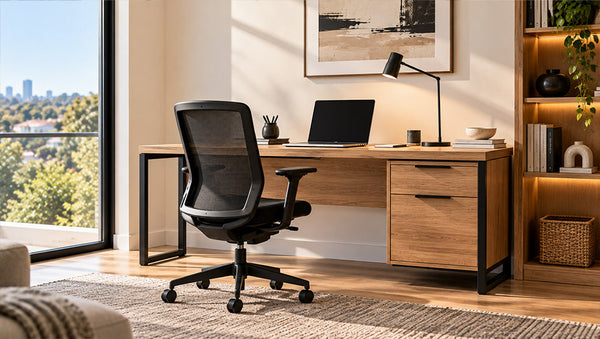
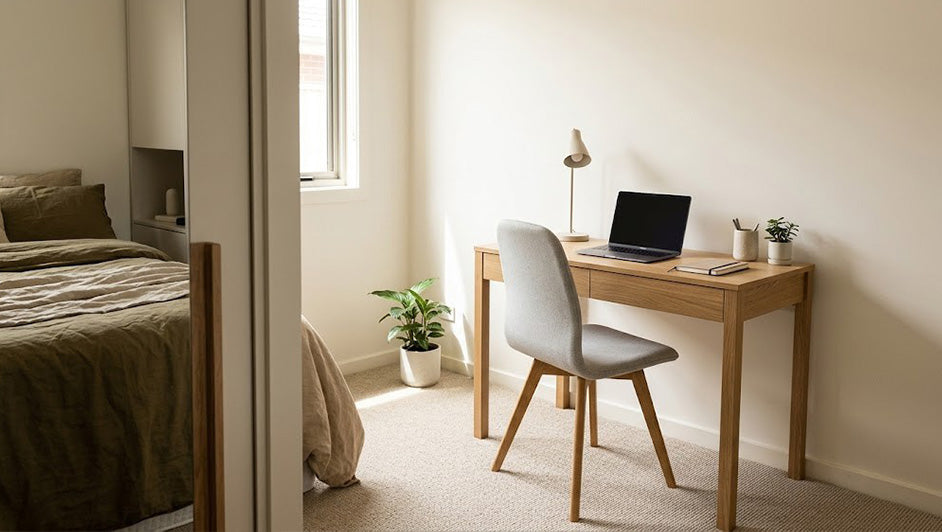
In the case of the desk in the home office of the majority of users, the best option is 120 cm by 60 cm. This would fit a laptop or 27-inch screen, a keyboard and a notebook; this desk would be fine in most cases to place in a bedroom.
-
Only laptop: or in the case of a small niche: 90-100 cm width, 50-60 cm depth
-
One 24 or 27-inch monitor: 120-140 cm width, 60-75 cm depth
-
Two monitors: 140-180 cm width, 75 cm depth or more
Having calculated your dimensions, make an allowance of 90 cm extra space behind the desk for a chair. If a desk placed against a wall leaves no space behind, you will have an impression of its non-fit. Now, when you have the dimensions, browse through our collection of home office desks.
Standard home office desk sizes in Australia
Most of the available desks in Australia come in very few standard width dimensions, whereas the height of the desk when sitting is 72 to 77 cm. In this case, all dimensions are available through us.
|
Size |
Width x depth x height (cm) |
Best for |
Example from our range |
|
Compact |
90 x 60 x 73 |
Laptop, homework, small nooks |
|
|
Small |
120 x 60 x 73 |
One monitor, most bedrooms |
|
|
Medium, shallow |
140 x 55 x 76 to 77 |
Laptop, or one monitor on an arm |
|
|
Medium deep |
150 x 75 x 73 |
One large monitor or two small ones |
|
|
Large with storage |
177.8 x 63.5 x 75 |
Drawers and workspace in one |
|
|
Large |
180 x 75 x 73 |
Two monitors, paperwork spread out |
|
|
Extra deep |
180 x 90 x 73 |
Two large monitors, drawing or design |
Lidcombe is available in 5 different sizes with a 25mm E1 Melamine top, cable cut-out, and 5-year warranty in order for you to measure your dimensions to near perfection. It should be noted that width and depth aren't everything. In case you are unsure whether 73cm or 77cm will meet your height needs, see the table below.
How much space a desk really takes
The desk itself is just one piece of the puzzle. Before you purchase the furniture, remember to include the following zones in your calculations.
The most important one is the chair zone. Allocate 90cm of free space from the front edge of the desk to the closest wall, bed or wardrobe. In case the chair has no armrests and no one will be walking behind you, 75 cm should do. Our article will help you decide what type of desk chairs you need.
A walkway should have about 60 cm of free space in case someone needs to pass while you are at the desk.
Don’t forget about the doors and wardrobes; a desk cannot be placed near a swinging door. Measure the radius of every door in the room and plan the placing of the furniture accordingly.
The power and the light sources are also important factors. An electric socket at hand will allow you to avoid laying wires along the floor.
In total, a 60cm desk will require 150cm of floor depth from the wall, while a 75cm desk will require about 165cm.
What size desk fits a small room?
The 60 cm rule is for chairs that are normally found in the dining room. There are many types of chairs, hence the need to measure the size of the chair first. This is how our chairs measure up.
|
Room or space |
Largest desk that usually works |
Why |
|
Hallway nook or under a window (about 1 to 1.2 m wide) |
90 x 60 cm |
Keeps the walkway clear |
|
Box room, about 2 x 2.5 m |
120 x 60 cm |
60cm desk + 90cm chair = 1.5m |
|
3 x 3 m bedrooms with a queen bed |
120 x 60 cm |
Only if the bed goes against a wall |
|
3 x 3m spare rooms, no bed |
150 x 75 cm to 180 x 75 cm |
Room for two monitors |
|
3.5m or larger study |
180 x 75 cm to 180 x 90 cm |
Space for a deep desk and storage |
A 3 x 3m bedroom with a queen bed
This is the layout configuration we get the most requests for. The dimensions of a queen-sized mattress are 153 x 203 cm, and most of the bed frames add an additional 5-15 cm in both directions, so plan on about 165 x 215 cm for the bed.
Centring the bed in the middle of the wall gives you about 67 cm on each side of the bed and 85 cm at its foot, enough for bedside tables, but not enough space for the desk and a chair.
However, if you push the bed to one of the walls, the space becomes much more spacious; you create a 135 cm strip of space next to the bed. A desk with the dimensions of 120 to 130 cm by 60 cm will fit against the wall at the end of that strip, and you can place the chair behind the bed.
Thus, yes, a 3 x 3 m room can have both a queen-sized bed and a 120 x 60 cm desk, provided that the bed goes to one of the walls. You are going to have a bedside table next to the wall with extra space. See our advice on how to choose a bedside table for your bedroom.
Spare rooms and nooks under 2.5m wide
Place the desk against the longest wall. A desk which is 60 cm deep with an additional 90 cm for the chair requires 1.5 m of room width, hence making the smallest space workable being 2 m wide. When placing the desk in a hallway nook or window alcove, a 90 cm desk suffices.
Desk size for a 27 inch monitor
A 27-inch widescreen monitor is 61cm wide and has a stand that occupies about 20 to 25cm of desk depth. Your seat should be at an arm's length away from the monitor.
The recommended width of the desk would be 100 cm for the computer screen and a mouse. Increase it to 120 cm for the extra space needed by a notebook or laptop. As for the depth of the desk, 60cm would do, but 70 to 75cm would make more sense since the monitor would be placed farther and your hands will not hang over the edge of the desk.
What about the desks that have smaller depths, such as 55 cm, like the Widden or Hampton? Get a monitor arm!
Desk size for two monitors
Two screens placed side by side occupy more width than one might think.
|
Setup |
Combined screen width |
Minimum desk |
Comfortable desk |
|
Two 24-inch monitors |
about 108cm |
120 x 60cm |
150 x 75cm |
|
Two 27-inch monitors |
about 122 cm |
150 x 75cm |
180 x 75cm |
|
One 27 inch + laptop |
about 95 cm |
120 x 60cm |
150 x 75cm |
If your room cannot accommodate a 150 cm desk, then a dual monitor arm allows the monitors to rest above the desk’s edge. Placing the monitors at an inward angle reduces the required straight line width.
Desk with storage vs regular desk
Drawers help a small room stay organised, but they take away leg space and require space to be opened. This is how they compare.
|
Desk with storage |
Regular desk |
|
|
Best for |
Bedrooms with no other storage, paperwork, a desk that doubles as a dresser |
Tight rooms where legroom matters, dual monitors |
|
Legroom |
Reduced on the drawer side |
Full width under the desktop |
|
Floor space |
Allow roughly 40 to 50 cm in front for drawers to open. |
Nothing to pull out |
|
Look |
More furniture-like, suits a bedroom |
Lighter and more minimal |
|
Example |
Albina 1.77 m (3 soft-close drawers plus a cabinet); Widden (2 drawers) |
Lidcombe in five sizes |

When it comes to a small space, consider the side that the drawers will be on. Place them opposite the bed or in the corner, allowing for free opening of the drawers. This is precisely the reason that the Albina exists in left and right-drawer variations.
Do you want ample legroom and storage space? Try combining a simple desk with a drawer unit.
A desk and chair under $500
One can easily have a perfect setup for their home office within $500, using either straight desk and ergonomic chair combinations, which are all available in our current lineup of desks and home office chairs.

|
Desk |
Chair |
Total |
|
Lidcombe 1200 x 600mm ($179) |
$408 |
|
|
Lidcombe 900 x 600mm ($149) |
$429 |
|
|
Lidcombe 1200 x 600mm ($179) |
$444 |
|
|
Lidcombe 1500 x 750mm ($239) |
Alaska Ergonomic Task Office Chair ($229) |
$468 |
Prices vary depending on our sales, and it is best that you check the product page to see the current price. The delivery cost will be calculated upon checkout using your postcode and the dimensions and weight of your order. For assistance in choosing your chair, you might want to visit our guide on selecting an office chair.
How to measure before you buy
First, take measurements from the corner to either the window frame or door frame or wardrobe, whichever comes first. Measure out from this wall to the bed or the wall opposite. Take your required depth plus 90cm.
Second, mark out the space using masking tape, both desk and chair zones, and spend a day living with it. It won't take you long to see whether or not it will work.
Third, make sure that you consider the position of your power points and windows. A desk in front of the window means glare on your computer screen; hence, a desk placed side-on to the window is better.
Fourth, check the access route. Most of our desks come flat-packed, but there are a few, such as the Hampton student desk, which comes in fully assembled form at 140cm. Make sure you have measured your doorways, hallways and stairs as our standard delivery is a box drop at ground level only.
Frequently asked questions
What is a standard desk width and depth?
Most home office desks are 120 to 150 cm wide and 60 to 75 cm deep, with a height of about 72 to 77 cm. A 120 x 60cm desk is the most practical size for a bedroom or small home office.
What size desk do I need for two monitors?
At least 120cm wide for two 24-inch monitors, or 150cm for two 27-inch monitors. For comfort, go 150 to 180 cm wide and 75 cm deep, or use a dual monitor arm on a smaller desk.
Can I fit a desk in a small bedroom?
Usually, yes. Allow the desk depth plus about 90 cm for the chair. In a 3 x 3 m bedroom with a queen bed, push the bed against one wall, and a 120 x 60 cm desk will fit in the space besides it.